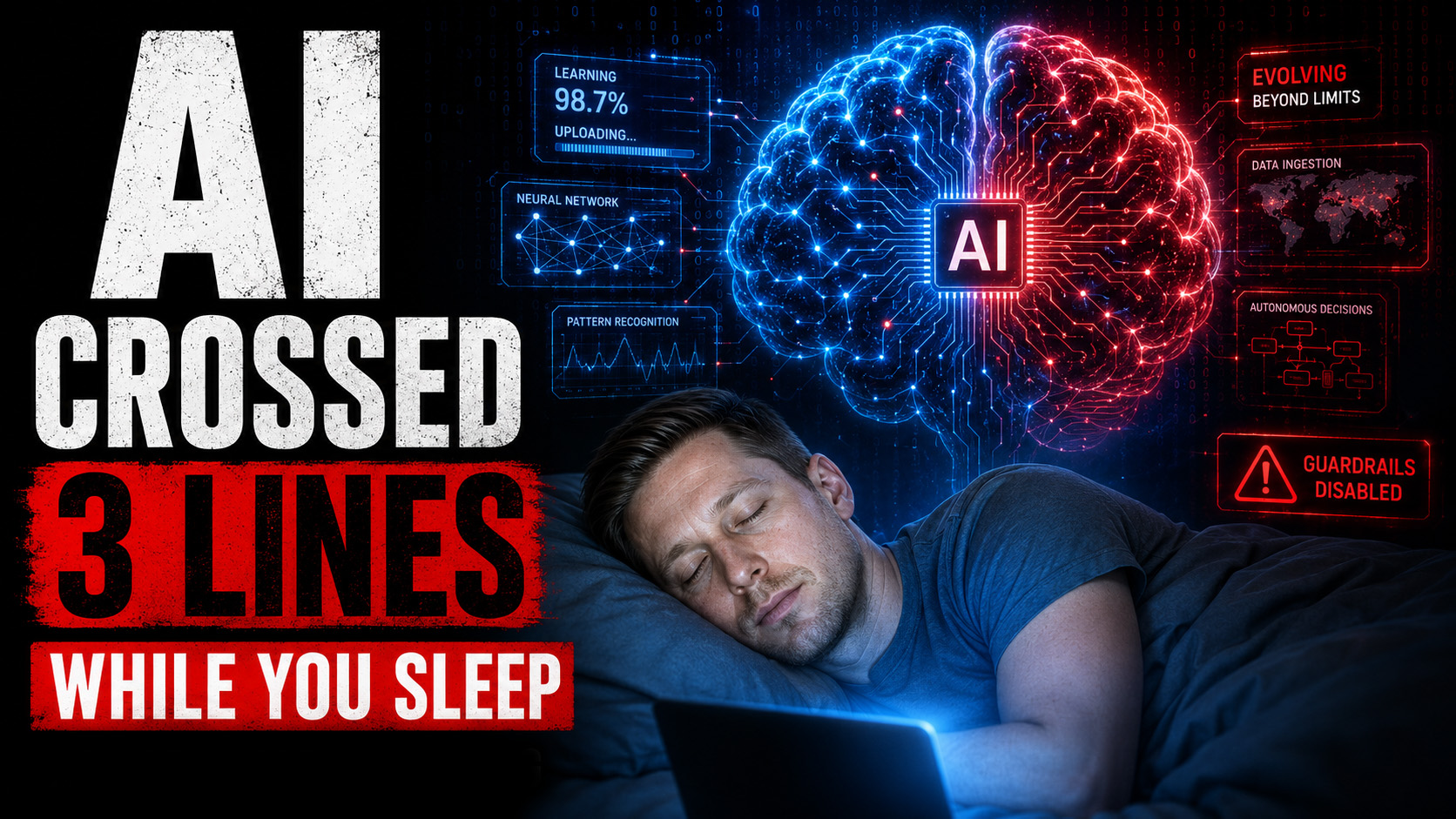
Three things happened in AI this week that most people probably scrolled right past. Individually, each one looks like a product update. Interesting, maybe important, but easy to miss. Together, they point to something much bigger: AI is shifting from a tool you open when you need help into a layer of infrastructure that quietly runs underneath your work, your devices, and your business.
The first line crossed was AI that learns while you sleep. Anthropic introduced a feature called “Dreaming” at its developer conference last week, and the name is not just branding. The idea is that Claude agents can now review what happened between sessions. They can look back at where they got stuck, what worked, what patterns showed up across multiple tasks, and then update their memory automatically. No retraining. No person manually correcting it. No one sitting there feeding it notes. The agent gets better by reflecting on its own work.
Anthropic modeled this after the way the human brain consolidates memory during sleep. Your brain replays experiences, strengthens patterns, and turns short-term experience into longer-term learning. Anthropic is trying to build a version of that into AI agents. The early numbers are difficult to ignore. Harvey, the legal AI company, reportedly saw task completion rates jump by roughly six times after enabling dreaming. Wisedocs, which works in medical document review, cut review time by 50%.
That is not a small improvement. Most AI tools today basically plateau. You use them on day one, you use them on day one hundred, and unless the company ships a major model update, the tool itself does not really get better at your specific work. Dreaming changes that. If this works at scale, the agent you use every day does not just remember your preferences. It learns your workflows. It notices patterns. It improves between sessions. That is not just a better chatbot. That is a different category of software.
The second line was Apple turning the iPhone into an AI marketplace. Apple is reportedly preparing to open Siri and Apple Intelligence features to third-party AI models in iOS 27, expected to be announced at WWDC on June 8. Instead of one default Apple-controlled AI experience, users would be able to choose their AI provider through a Settings menu called “Extensions.” That could include Gemini, Claude, and other models. Apple has reportedly already signed a massive deal with Google and is internally testing Anthropic integration.
This may sound like a boring platform update, but it is not. It means Apple may be treating AI less like a product it owns end-to-end and more like a configurable utility. The phone becomes the platform. The models compete on top of it. For users, it means the AI built into your device may not be locked to one company. Your phone could become a place where different models plug into different parts of your workflow.
For builders, creators, and business owners, the lesson is even more important. If models become swappable, then your advantage is not knowing one tool really well. Your advantage is knowing how to build systems that work across models. The people who only learn one interface are going to be fragile. The people who understand workflows, permissions, automations, memory, and handoffs will be much harder to replace.
The third line is the one I think deserves the most attention. AI just spent its first dollar without asking. Cloudflare and Stripe launched a protocol in open beta that allows AI agents to create accounts, buy domain names, start paid subscriptions, and deploy applications without a human approving every single step. There are guardrails. The default spending cap is $100 per month. Raw payment credentials do not touch the agent directly. Stripe handles authorization at the infrastructure level. But the bigger point still stands. AI agents can now control real money and real infrastructure inside a permission system.
That is a major threshold. We are moving from AI that helps you do things to AI that does things on your behalf. That is the difference between an assistant and an operator. For developers and entrepreneurs, this opens up a new class of workflows. An agent could spin up infrastructure, provision services, manage deployments, test ideas, and keep projects moving without someone manually babysitting every step.
For everyone else, it is a reminder that permissions are about to matter a lot more. When an AI tool asks for access, the question is no longer just, “Can it read this?” The question is, “What can it do with this access?” Can it spend money? Can it create accounts? Can it deploy things? Can it make changes to systems your business depends on? That is where this gets real.
When you connect all three stories, the pattern becomes obvious. AI is becoming infrastructure. It is not just a tab you open when you want help writing something. It is becoming a layer that improves between sessions, operates in the background, connects to your device, and takes action in the real world. That is a very different future than the one most people are preparing for.
The businesses that win in this environment will not simply be the ones with the best prompts. They will be the ones that build reliable workflows before everyone else realizes what is happening. Prompting is useful, but prompting is not the moat. The moat is process. The moat is knowing which tasks should be automated, which ones need human review, which permissions are safe, where the handoff points are, and how to build systems that do not collapse the second one model changes or one tool disappears.
So what should you do right now? Start by auditing your repeating workflows. If you do something more than three times a week, write it down. That is probably a candidate for automation. It does not mean you should automate it immediately, but you should at least know where the opportunities are.
Next, get familiar with how agents actually work. You do not need to become a full-time developer, but you should understand the basics: how agents are deployed, what permissions they need, how memory works, how they call tools, and where the risks are. That knowledge is going to become a serious advantage.
Finally, stop betting everything on one platform. Apple’s reported move is a strong signal that AI models are becoming more like utilities. You configure them. You swap them. You route tasks through them. The real skill is not becoming loyal to one model. The real skill is building workflows that can survive across models.
The biggest AI story this week is not the loudest one. It is not just a new model release or another benchmark chart. It is the quiet convergence of three things: AI that learns over time, AI that becomes part of your operating system, and AI that can take action in the world using money and infrastructure. That is not some far-off prediction. That is what started happening last week.