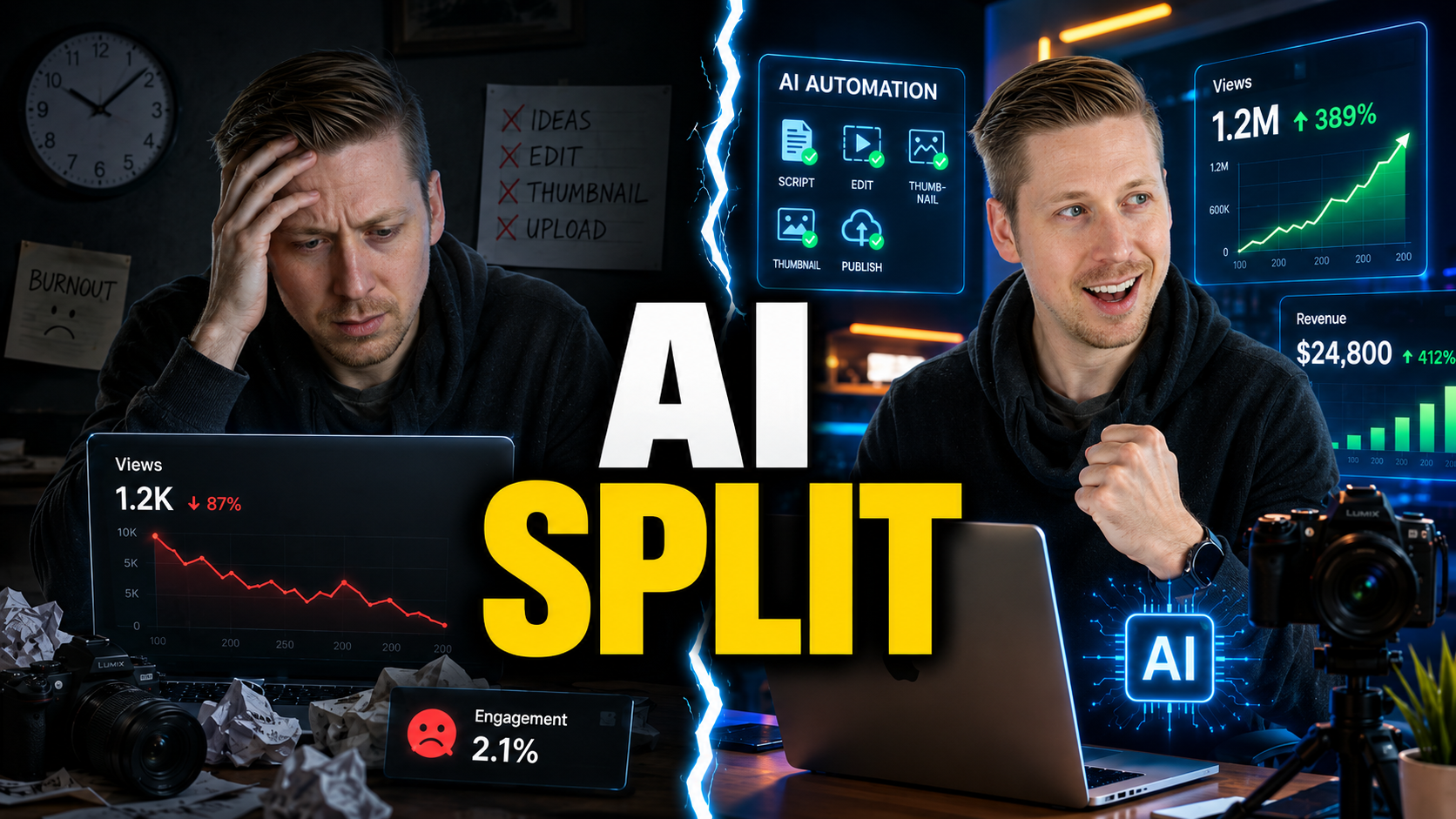
The numbers are starting to show what a lot of people have felt but haven’t fully said out loud yet. AI isn’t just changing the market. It’s splitting it.
On one side, writing jobs on Upwork are down 32% year over year in 2025, which is the biggest decline of any category on the platform. Entry-level creative projects have dropped from 15% of available work to under 9%. That means a lot of the lower-end freelance economy is being eaten alive.
But on the other side, Anthropic is reportedly doing $44 billion in annual recurring revenue. OpenAI just shipped GPT-5.5 only six weeks after GPT-5.4. AI-specialized freelancers are charging 25% to 60% more than generalists. So the question is not, “Is AI good or bad for creators?” The better question is: which side of the market are you on?
Both things are happening at the same time. Some people are losing work because AI can now do the basic version of what they used to get paid for. Other people are making more money because they learned how to use AI to move faster, think bigger, and offer more value. That is the real story.
The pace is the problem. Most people still think of AI as something they should “learn eventually,” but that mindset is already outdated. In the last couple of months alone, Anthropic has pushed multiple major Claude updates. Chinese AI labs like Z.ai, MiniMax, Moonshot, and DeepSeek are releasing competitive coding models at a pace that would have sounded impossible a few years ago. OpenAI keeps compressing its release cycles. Google is pushing Gemini deeper into search, productivity, robotics, and enterprise systems.
This is not a normal technology cycle. This is not the internet slowly becoming useful. This is software evolution happening in compressed time. The people treating AI like a future trend are going to be surprised when they realize the future already showed up and started charging invoices.
The enterprise world already understands this. While creators are still debating whether AI is “real work,” large companies are already reorganizing around it. Banks, pharmaceutical companies, cloud platforms, software companies, agencies, and enterprise teams spent the last year testing AI. Now they are deploying it.
That matters because the companies creators work with are changing. The clients entrepreneurs sell to are changing. The platforms we build on are changing. The expectations around speed, output, and cost are changing. AI is not coming for the market. It is already inside the market. Once clients realize they can get certain types of work done faster, cheaper, and with fewer people, the old version of the service business starts to break.
That does not mean humans stop mattering. It means the value moves. The value is no longer in doing the basic task. The value is in judgment, taste, strategy, direction, context, personality, and curation. It is in knowing what to make, why it matters, who it is for, and how to turn it into something useful. AI can generate, but someone still has to direct. That is where the opportunity is.
The creator economy is not disappearing. It is polarizing. The creators who are being pushed out are usually the ones selling the same work, the same way, with the same process they used in 2023. The creators who are growing are the ones who understand that AI does not remove the need for humans. It changes what humans are paid for.
You do not win by competing with AI at the task level. You win by becoming the person who knows how to use AI to create better outcomes. That might mean building faster content systems, creating better research workflows, turning ideas into scripts, visuals, posts, emails, landing pages, and products faster, or helping businesses understand how to actually use these tools. Your process becomes more valuable because AI is part of it, not because you are pretending AI does not exist.
The premium is moving toward people who can combine human insight with AI execution. That is the lane.
If you are a creator, consultant, freelancer, marketer, designer, writer, editor, founder, or agency owner, this is the week to stop thinking about AI as an optional tool. Audit your workflow. Ask where you are still doing manual work that AI could speed up. Ask where you are spending hours on tasks that should take minutes. Ask where you are using AI like a search box instead of a production system. Ask where you could turn your knowledge of AI into content, services, products, or a stronger personal brand.
Most importantly, make your AI knowledge visible. The market is starting to reward people who can bridge the gap between business strategy and AI implementation. Not the people who just say “AI is coming,” but the people who can show how to use it.
The AI economy is splitting. One side is becoming cheaper. The other side is becoming more valuable. The side you end up on will depend on how seriously you take the next 90 days.